Solar panels need sunlight to perform well. However, many people focus only on buying quality panels. They often overlook one important factor: panel angle.
The angle of your solar panels can greatly affect energy production. Even the best panels can underperform if they are installed incorrectly. Therefore, understanding the best panel angle for maximum output is essential.
Whether you own a home, business, or industrial facility, proper panel positioning can help you generate more electricity. As a result, you enjoy better performance and a faster return on investment.
In this guide, we explain how solar panel angles work, why they matter, and how to maximize solar output throughout the year.
Why Solar Panel Angle Matters
Solar panels work by capturing sunlight and converting it into electricity. The more direct sunlight they receive, the more energy they generate.
When sunlight hits a panel at the correct angle, energy production increases. However, if the angle is too steep or too flat, some sunlight is lost.
Therefore, panel angle directly affects:
- Energy production
- Charging efficiency
- Battery performance
- System reliability
- Long-term savings
Even a small adjustment can improve output significantly.
What Is Solar Panel Tilt Angle?
The tilt angle is the angle between the solar panel and the ground.
For example:
- A flat panel has a tilt angle of 0°
- A panel standing upright has a tilt angle of 90°
- Most solar installations fall between 5° and 40°
The goal is simple. Position the panel so it receives maximum sunlight during the day.
The Best Panel Angle Depends on Location
There is no universal angle for every installation.
The best panel angle depends largely on geographic location.
Areas closer to the equator generally require lower tilt angles. Meanwhile, locations farther away need steeper angles.
Nigeria is located near the equator. Therefore, solar panels generally perform well with moderate tilt angles.
For many locations across Nigeria, a tilt angle between 10° and 20° often provides excellent year-round performance.
However, exact recommendations may vary depending on:
- City location
- Roof structure
- Available space
- Shading conditions
- Energy goals
Recommended Solar Panel Angles in Nigeria
Although solar systems can work at various angles, the following ranges are commonly effective:
Southern Nigeria
Cities such as:
- Lagos
- Port Harcourt
- Benin City
- Calabar
Often perform well with panel angles between 10° and 15°.
Central Nigeria
Cities such as:
- Abuja
- Lokoja
- Makurdi
Often benefit from tilt angles around 12° to 18°.
Northern Nigeria
Cities such as:
- Kano
- Kaduna
- Maiduguri
May perform better with angles between 15° and 20°.
These figures serve as general guidelines. Professional site assessments provide the most accurate results.
Fixed Angle vs Adjustable Angle
Solar systems generally use one of two approaches.
Fixed Angle Systems
These systems remain at one angle throughout the year.
Advantages include:
- Lower installation costs
- Simpler maintenance
- Greater durability
- Easier installation
Therefore, fixed-angle systems are the most common option for homes and businesses.
Adjustable Angle Systems
These systems allow seasonal adjustments.
Advantages include:
- Improved efficiency
- Higher annual production
- Better seasonal optimization
However, they require more maintenance and higher installation costs.
For most Nigerian installations, a properly selected fixed angle delivers excellent performance.
How Roof Design Affects Panel Angle
Roof design often determines available panel angles.
For example:
Pitched Roofs
Many residential roofs already have a suitable angle.
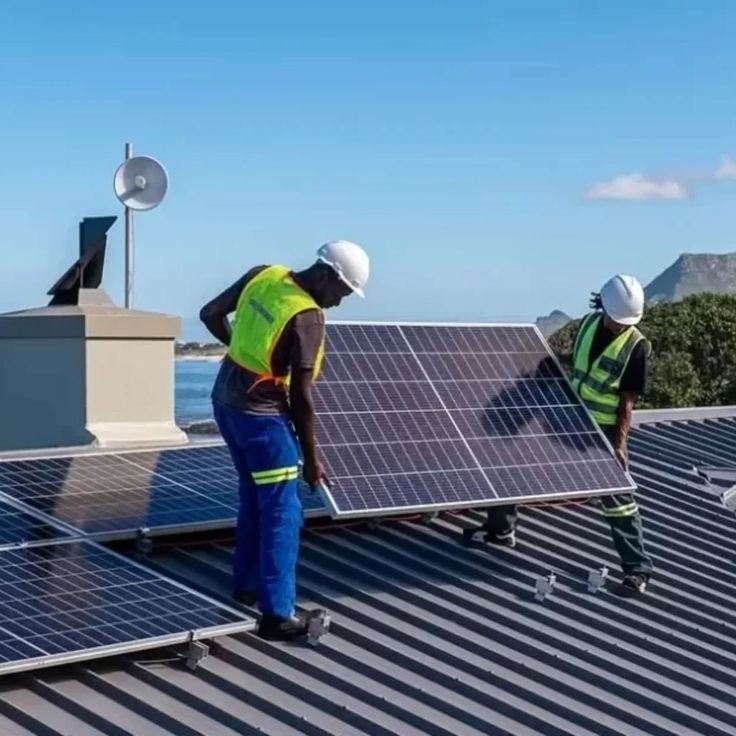
In such cases, installers simply mount the panels directly on the roof structure.
Flat Roofs
Flat roofs require mounting structures.
These supports elevate the panels and create the desired tilt angle.
As a result, flat roofs can still achieve excellent solar performance.
Common Angle Mistakes That Reduce Output
Many solar owners unknowingly lose energy because of poor installation decisions.
Panels Installed Completely Flat
Flat panels may collect dirt and water more easily.
Consequently, efficiency drops over time.
Excessive Tilt Angles
Very steep panels may reduce sunlight exposure during certain months.
Therefore, energy production becomes inconsistent.
Ignoring Shade Patterns
Even a perfect angle cannot compensate for shading.
Trees, buildings, and poles can reduce solar generation significantly.
Poor Orientation
Panels should face the direction that receives the most sunlight.
Incorrect orientation often reduces performance more than tilt angle errors.
How Panel Angle Affects Rainwater Cleaning
An overlooked benefit of proper tilt is self-cleaning.
Rainwater naturally washes away:
- Dust
- Dirt
- Bird droppings
- Leaves
However, panels installed too flat may retain debris.
Consequently, sunlight absorption decreases.
Therefore, maintaining a suitable angle improves both cleanliness and performance.
Seasonal Considerations
Solar energy production changes throughout the year.
During dry seasons, sunlight is usually stronger and more consistent.
Meanwhile, rainy seasons bring:
- Cloud cover
- Reduced sunlight
- Increased moisture
A properly chosen panel angle helps maximize available sunlight in both seasons.
This is particularly important for Nigerian homes that rely heavily on solar power.
Real-Life Example
Consider two homes using identical solar equipment.
Both have:
- The same inverter
- The same batteries
- The same solar panels
However, one system is installed at an optimized angle.
The second system is installed too flat.
After several months, the optimized system consistently produces more energy. The batteries charge faster. The homeowner enjoys longer backup power.
Meanwhile, the poorly angled system struggles to achieve the same results.
This example shows why installation quality matters just as much as equipment quality.
Tips for Maximum Solar Output
To achieve the best results:
- Choose the correct tilt angle
- Avoid shading
- Clean panels regularly
- Use quality mounting structures
- Schedule routine inspections
- Monitor system performance
- Work with experienced installers
Furthermore, always consider future expansion when designing your system.
Why Professional Installation Matters
Many solar problems begin during installation.
A professional installer evaluates:
- Roof structure
- Sun exposure
- Panel placement
- Angle optimization
- Future energy needs
As a result, your system delivers maximum value over its lifetime.
At Jeho Ashar Energy, every installation is designed for efficiency, reliability, and long-term performance.
You can learn more about professional solar solutions at https://www.abujasolar.com.
Conclusion
Choosing the best panel angle for maximum output is one of the most important decisions in solar installation. Even high-quality solar equipment can underperform if positioned incorrectly.
Fortunately, proper panel angles improve energy generation, battery charging, and overall system efficiency. In addition, they help keep panels cleaner and more productive throughout the year.
For homeowners and businesses alike, investing in proper solar design delivers long-term rewards.
Final Thought
Solar success is not only about buying good equipment. It is also about installing it correctly. The right panel angle can make the difference between average performance and exceptional results. Therefore, always work with experienced solar professionals who understand how to maximize every ray of sunlight.