
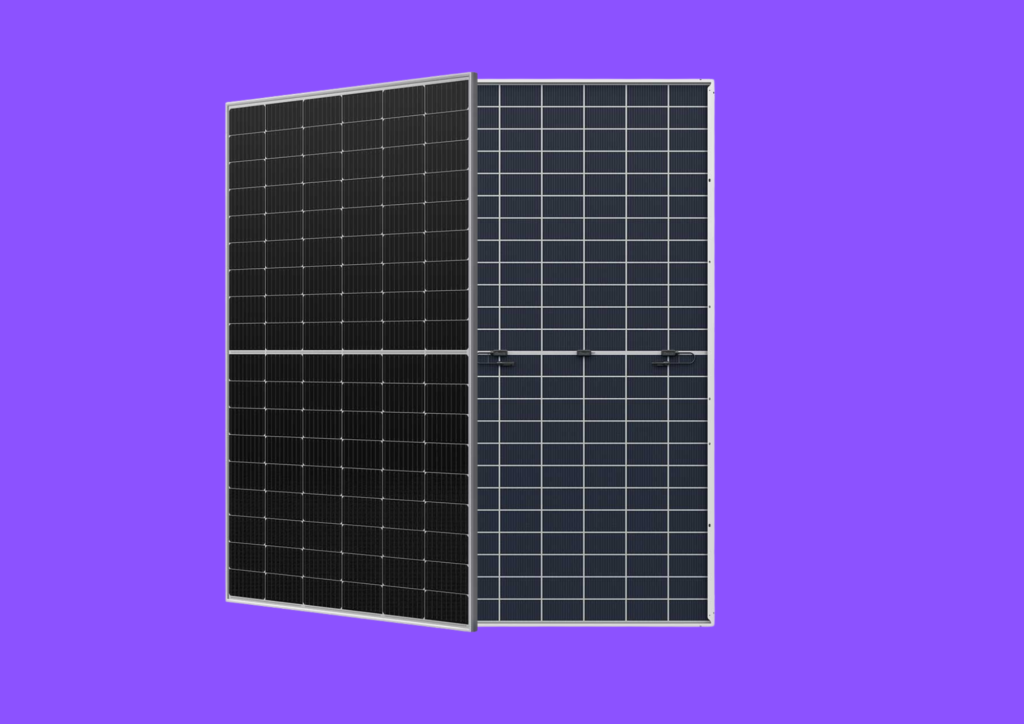
Most solar panels face the sun directly. However, sunlight does not only reach their front surface. Some light also reaches the ground and nearby surfaces. A bifacial solar panel is designed to use more of that available light.
Unlike a traditional monofacial panel, a bifacial panel can generate electricity from both sides. Its front side captures direct sunlight. Meanwhile, its rear side captures useful light reflected from the surroundings.
This design can increase total energy production. However, the extra energy does not come from nowhere. It depends on the installation environment, panel height, surface reflectivity, spacing, and system design.
Therefore, understanding how bifacial panels generate extra energy is important. It helps buyers know when bifacial technology can provide real value.
What Is a Bifacial Solar Panel?
A bifacial solar panel can generate electricity from its front and rear sides.
The front receives direct sunlight. The rear receives reflected and scattered light from the surrounding environment.
This is possible because the rear side of the solar cells remains capable of converting light into electricity. Many modern bifacial modules also use transparent or dual-glass construction. This allows more light to reach the rear cells.
The result is simple. Instead of using only the light reaching the front, the panel can also capture useful light arriving from behind.
Monofacial vs Bifacial Panels
A monofacial panel mainly generates electricity from its front side. Its rear side is not designed to contribute meaningful power generation.
A bifacial panel works differently. Both sides participate in electricity generation.
The basic difference looks like this:
- Monofacial: Front-side generation.
- Bifacial: Front and rear-side generation.
- Monofacial: Less dependent on ground reflectivity.
- Bifacial: Benefits from reflective surroundings.
- Monofacial: Simple installation requirements.
- Bifacial: Requires more careful installation planning.
Therefore, bifacial technology becomes especially useful when the installation allows light to reach the rear of the module.
How Does the Rear Side Generate Power?
The process begins with sunlight.
Some sunlight hits the front of the panel directly. Another portion reaches the ground or nearby surfaces.
That light can then reflect upward. Some of the reflected light reaches the rear of the bifacial panel. The rear solar cells absorb this light and convert it into electricity.
This additional contribution is known as bifacial gain.
The amount of gain varies from one installation to another. It is not a fixed percentage for every project.
Several factors influence it, including:
- Ground surface.
- Panel height.
- Panel spacing.
- Row spacing.
- Sun position.
- Shading.
- Panel orientation.
- Rear-side accessibility.
- Module bifaciality.
As a result, two identical bifacial panels can produce different rear-side gains.
What Is Bifacial Gain?
Bifacial gain refers to the additional energy produced because the rear side receives usable light.
Imagine a panel producing 600W from front-side sunlight under a particular condition. If its rear side receives useful reflected light, total output can increase beyond the front-side contribution.
However, the increase will depend on the available rear-side irradiance.
This is important because bifacial panels are not automatically 20% or 30% more productive. The actual gain depends heavily on the installation.
A poorly designed installation may provide little rear-side light. A well-designed installation can make much better use of the technology.
Ground Reflectivity Matters
One of the biggest factors is the surface below the panels.
Different surfaces reflect different amounts of sunlight. This property is commonly described as albedo.
For example, dark surfaces usually reflect less light. Lighter surfaces generally reflect more.
Common surfaces include:
- Grass.
- Soil.
- Concrete.
- Sand.
- Gravel.
- Light-colored roofing.
- White surfaces.
A brighter surface can therefore send more reflected light toward the rear of a bifacial panel.
This does not mean every project needs a white surface. Instead, it shows why the surrounding environment matters.
For instance, a bifacial system installed above a highly reflective surface can have stronger rear-side illumination than one installed close to dark soil.
Why Panel Height Matters
The distance between the panel and the surface also affects bifacial performance.
When panels sit very close to the ground, the rear side may receive less useful reflected light. The surrounding structure can also block some of that light.
Raising the panels can improve access to light from different directions. However, increasing height also affects structural requirements, wind loading, cost, and installation safety.
Therefore, height should be selected carefully.
A professional installer should balance bifacial performance with structural stability and project economics.
Panel Spacing Also Makes a Difference
Spacing affects how much light reaches the rear side.
Panels installed too closely together can reduce rear-side exposure. Row spacing also affects shading between rows.
Consequently, large solar installations need careful layout planning.
The goal is not simply to install as many panels as possible. Instead, the layout should support strong overall energy production.
For commercial and industrial systems, this becomes particularly important. Small improvements in energy yield can become significant when multiplied across hundreds of panels.
Bifaciality: An Important Specification
Another important specification is the bifaciality factor.
It describes how effectively the rear side can generate power compared with the front side under comparable test conditions.
For example, a higher bifaciality factor means the rear side has stronger generation capability when useful light reaches it.
Modern N-type TOPCon modules can offer high bifaciality. JinkoSolar’s current Tiger Neo 3.0, for example, lists bifaciality of up to 85±5%, depending on the specific product specification.
However, bifaciality alone does not determine actual energy gain.
A high-bifaciality module still needs suitable rear-side light. Without enough reflected light, the additional potential cannot be fully used.
Why N-Type Bifacial Panels Are Popular
Many modern bifacial panels use N-type cell technology.
N-type TOPCon modules combine high efficiency with strong bifacial performance. This makes them attractive for projects where maximizing energy production is important.
For example, current Jinko Tiger Neo products include N-type bifacial modules in several power classes. Jinko also lists high bifaciality, low degradation, and optimized temperature coefficients among the technology’s features.
This combination can be useful for large commercial and industrial systems.
However, buyers should still compare the complete module specification. Bifaciality should not be considered in isolation.
Where Do Bifacial Panels Work Best?
Bifacial panels can work across many applications.
However, some installations provide better conditions for rear-side generation.
1. Ground-Mounted Solar Systems
Ground-mounted systems can provide excellent rear-side access.
Panels can be elevated above the ground. This allows reflected light to reach the rear surface.
The ground can also be selected or prepared to improve reflectivity.
2. Commercial and Industrial Installations
Large facilities can benefit from bifacial technology.
Warehouses, factories, and industrial sites may have large open areas. These spaces can provide suitable layouts for bifacial systems.
Additionally, the scale of these projects can make even moderate energy gains valuable.
3. Carports and Solar Canopies
Solar carports are another useful application.
Panels are elevated above parking spaces. Therefore, the rear side can remain exposed to surrounding light.
The design can also provide shade while producing electricity.
4. Reflective Roof Installations
Some rooftops can also support bifacial panels.
Light-colored roofing can reflect additional sunlight toward the rear side. However, the mounting structure must allow enough space beneath the modules.
A panel installed directly against a roof will not receive the same rear-side exposure as an elevated system.
Can Bifacial Panels Work in Nigeria?
Yes, they can.
However, the design should match the local environment.
Nigeria receives strong solar radiation in many regions. That creates significant potential for solar generation. At the same time, dust, heat, rainfall, shading, and installation conditions must be considered.
For bifacial systems, the surrounding surface becomes particularly important.
A commercial installation with elevated panels and suitable ground conditions may benefit more than a tightly mounted rooftop system.
Therefore, a proper site assessment should come before selecting the module.
Do Bifacial Panels Always Produce More Energy?
Not necessarily.
Bifacial panels have the potential to produce more energy. However, their additional gain depends on the installation.
For example, consider two identical bifacial panels.
The first panel sits above a reflective surface. Its rear side receives plenty of reflected light.
The second sits very close to a dark surface. Its rear side receives little useful light.
Both panels have the same rated specifications. Yet their actual bifacial gains can be very different.
This is why installation design matters as much as panel selection.
Common Mistakes With Bifacial Panels
Several mistakes can reduce the expected rear-side gain.
Blocking the Rear Side
Structures should not unnecessarily block the rear surface.
Rails, mounting components, and other obstructions should be considered during design.
Installing Panels Too Low
Very low mounting can reduce rear-side exposure.
It can also limit the amount of reflected light reaching the cells.
Ignoring the Ground Surface
The surface beneath the panels affects available reflected light.
Therefore, the ground should be considered during system planning.
Creating Excessive Row Shading
Poor spacing can cause rows to shade one another.
This can reduce both front-side and rear-side performance.
Focusing Only on Rated Wattage
A panel’s wattage is not the complete story.
Bifaciality, efficiency, temperature coefficient, degradation, dimensions, and warranty should also be reviewed.
How to Get More From Bifacial Panels
If you are considering bifacial technology, follow these practical steps:
- Assess the installation location.
- Check the surface beneath the panels.
- Review available mounting height.
- Plan suitable row spacing.
- Reduce unnecessary rear-side shading.
- Check the module’s bifaciality specification.
- Consider panel orientation carefully.
- Match panels with the correct inverter.
- Use suitable mounting structures.
- Have the system professionally designed.
These steps can help the panels perform closer to their potential.
Bifacial Panels and Jeho Ashar Energy
Choosing the right panel is only one part of a solar project.
The panels must work properly with the inverter, battery, protection devices, cables, and mounting structure.
At Jeho Ashar Energy, customers can source solar equipment for residential, commercial, and industrial applications. The product range includes Jinko solar panels, Deye hybrid and high-voltage inverters, lithium batteries, rails, cables, and protective devices.
For customers considering high-efficiency solar solutions, the available Jinko range includes modern bifacial options designed for stronger energy production.
You can explore available solar solutions and products at https://www.abujasolar.com.
Is Bifacial Technology Worth Considering?
Bifacial panels can provide meaningful advantages when the site supports rear-side generation.
They can make better use of available sunlight. They can also improve energy production without requiring additional panel surface area.
However, the technology should be evaluated based on the entire installation.
Consider the following before deciding:
- Available roof or ground space.
- Surface reflectivity.
- Mounting height.
- Shading conditions.
- Panel spacing.
- Local weather conditions.
- Energy requirements.
- Total installation cost.
- Expected energy yield.
A professional site assessment can help determine whether the additional bifacial potential is useful for your project.
Conclusion
Bifacial panels generate extra energy by using both sides of the solar module.
The front side captures direct sunlight. Meanwhile, the rear side captures useful reflected and scattered light.
However, the amount of extra energy depends on the installation. Ground reflectivity, mounting height, spacing, shading, orientation, and panel technology all play important roles.
Therefore, buying a bifacial panel is only the beginning. The system must also be designed to give its rear side enough access to light.
When properly planned, bifacial technology can help solar systems produce more energy from the same basic panel footprint. That makes it an important option for modern residential, commercial, and industrial solar projects.
Final Thought
Bifacial panels show that solar generation is not only about what happens on the front.
The space around a panel matters too. With the right design, reflected sunlight can become useful additional energy.
Learn more about quality solar solutions at https://www.abujasolar.com