Choosing a solar battery involves important decisions.
Battery capacity is only one consideration.
Battery voltage also matters greatly.
Deye offers different energy storage solutions.
These include low-voltage and high-voltage systems.
Both can support modern solar installations.
However, they work differently within systems.
They also suit different project requirements.
A 48V battery system may suit homes.
A high-voltage system may suit larger applications.
Yet, the right choice depends on several factors.
These include inverter compatibility and system size.
Load requirements also influence the decision.
Installation design matters as well.
Therefore, understanding Deye LV vs HV batteries helps.
It makes battery selection much easier.
What Does LV Mean?
LV means Low Voltage.
Deye has 48V-class battery systems available.
For example, the SE-G5.1 uses 51.2V nominal voltage.
Its operating range is 44.8V to 57.6V.
These batteries use LiFePO₄ chemistry.
They are designed for energy storage applications.
The voltage remains relatively low.
Therefore, systems often use higher current.
For example, Deye’s SE-G5.1 provides 5.12kWh.
It supports up to 50A continuous current.
Its peak current reaches 100A briefly.
This makes LV systems practical for many homes.
They can also support expandable storage configurations.
What Does HV Mean?
HV means High Voltage.
These batteries operate above typical 48V systems.
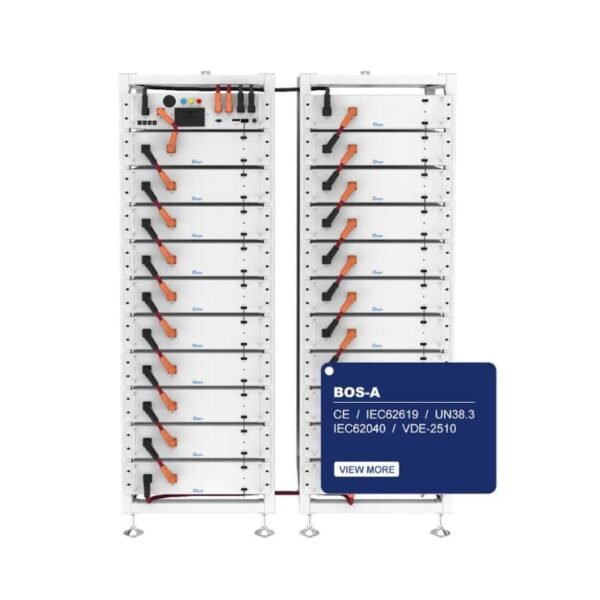
Deye’s HV storage systems can use multiple modules.
Those modules connect in series for higher voltage.
For example, the Deye BOS-G uses 51.2V modules.
Several modules can connect in series.
Depending on configuration, system voltage can rise significantly.
The BOS-G supports systems from 15.36kWh upward.
Its listed configurations can reach 61.44kWh.
Therefore, HV systems are suited to larger storage needs.
Deye LV vs HV Batteries: The Main Difference
The biggest difference is operating voltage.
LV systems operate around the 48V range.
HV systems operate at much higher voltages.
This changes how current flows through the system.
For the same power output, higher voltage means lower current.
Lower current can reduce cable losses.
It can also allow smaller conductors in suitable designs.
Deye explains that HV systems can offer reduced energy losses.
They can also suit larger loads and higher power requirements.
However, higher voltage adds complexity.
Installation also requires appropriate safety procedures.
Therefore, voltage should match the project.
LV Batteries Are Often Practical For Homes
Low-voltage storage has several practical advantages.
A 48V-class system is familiar to installers.
It can also be straightforward for residential applications.
Deye’s LV batteries can be connected in parallel.
This allows additional storage capacity when supported.
For example, the SE-G5.1 supports multiple packs in parallel.
LV systems can therefore grow with energy needs.
They can be useful for:
- Residential solar systems
- Smaller businesses
- Backup power systems
- Moderate energy storage
- Existing 48V inverter systems
However, compatibility remains essential.
A battery should match the inverter.
Communication requirements must also be checked.
HV Batteries Suit Larger Energy Systems
High-voltage batteries become more attractive at larger scales.
Why?
Higher voltage allows the system to deliver power.
It does so with less current than LV systems.
This can offer important design advantages.
For instance, larger installations may have higher power demands.
Running everything at low voltage can require substantial current.
HV storage can reduce that current requirement.
Deye’s BOS-G is designed for small-scale C&I storage.
It uses multiple battery modules connected in series.
Therefore, HV storage can suit larger homes.
It can also suit commercial and industrial projects.
LV vs HV: Current Requirements
Current is an important technical difference.
Power is related to voltage and current.
When voltage increases, required current can decrease.
This happens when power remains the same.
For example, a system delivering significant power at 48V.
It can require very high battery current.
A higher-voltage system can deliver similar power.
It can do so with lower current.
This can affect cable requirements.
Lower current can mean reduced cable losses.
It can also simplify some larger system designs.
However, actual cable selection requires proper engineering.
Installers should follow manufacturer specifications.
Installation Complexity Is Different
LV systems are generally simpler to understand.
They also use lower battery voltages.
Deye describes LV solutions as safer and more flexible.
The company also highlights their easier expansion.
HV systems require more careful installation.
The higher voltage demands appropriate safety procedures.
Installers should use suitable protective equipment.
They should also follow the manufacturer’s instructions.
Deye’s documentation emphasizes qualified personnel for battery work.
Therefore, installation quality becomes especially important.
Safety Considerations
Both battery types require proper safety practices.
However, HV systems require additional attention.
Higher voltage creates greater electrical hazards.
Installers should therefore:
- Follow Deye installation instructions.
- Use appropriate protective equipment.
- Confirm correct battery configuration.
- Check all electrical connections.
- Use compatible protection devices.
- Verify communication connections.
- Keep unauthorized personnel away.
- Follow local electrical requirements.
Battery installation should not be improvised.
Professional installation protects both people and equipment.
LV Batteries Offer Flexible Expansion
One benefit of LV systems is scalability.
Deye’s SE-G5.1 supports multiple battery packs.
The manufacturer lists up to 64 packs in parallel.
That provides substantial expansion potential.
However, expansion should still be planned carefully.
The inverter must support the additional capacity.
Cables must also handle the increased current.
Battery compatibility is equally important.
Therefore, adding batteries is not simply plug-and-play.
HV Systems Can Reduce Large-System Current
HV storage offers another important benefit.
Large systems often require significant power.
At lower voltage, this means higher current.
Higher current can increase electrical losses.
It can also increase cable requirements.
HV systems reduce the current needed for equivalent power.
Therefore, they can be useful for larger installations.
This does not make HV automatically better.
It simply makes HV suitable for different applications.
The project requirements should determine the choice.
Energy Capacity Is Not the Same As Voltage
This distinction is very important.
Battery voltage does not equal battery capacity.
For example, a 51.2V battery can store 5.12kWh.
Another system can use several modules together.
Likewise, an HV system may combine modules.
The resulting system can provide much greater capacity.
Therefore, do not compare batteries by voltage alone.
Always consider:
- Nominal voltage
- Energy capacity
- Usable energy
- Continuous current
- Peak current
- Inverter compatibility
- Communication protocol
- Expansion capability
- Installation requirements
This creates a much clearer comparison.
Deye LV vs HV Batteries: A Simple Comparison
| Feature | Deye LV Batteries | Deye HV Batteries |
|---|---|---|
| Typical voltage | Around 48–51V | Much higher system voltage |
| Common application | Residential | Larger residential and C&I |
| Current requirement | Higher | Lower for equivalent power |
| Expansion | Parallel configurations | Series-based modular configurations |
| Installation | Generally simpler | More complex |
| Cable current | Higher | Lower |
| System design | Straightforward | More specialized |
| Large loads | Possible within limits | Often better suited |
| Safety requirements | Important | More demanding |
| Best choice | Depends on system | Depends on system |
This table provides a general comparison.
Actual specifications vary by Deye model.
Which Deye Battery Should You Choose?
There is no single answer for everyone.
Your inverter should be the starting point.
Check its supported battery voltage first.
Then consider your power requirements.
An LV system may make sense when:
- You have a residential installation.
- Your inverter supports 48V batteries.
- Your loads are moderate.
- You want simple expansion.
- Your system is already LV-based.
An HV system may make sense when:
- Your loads are larger.
- Your inverter supports HV storage.
- You need substantial battery capacity.
- Lower battery current is beneficial.
- You are designing a larger system.
The final choice should follow proper assessment.
Example: Two Different Projects
Consider a four-bedroom home.
The homeowner uses moderate appliances.
They want evening backup and essential loads.
A compatible Deye LV battery system may be suitable.
Additional batteries can provide more storage when required.
Now consider a commercial facility.
It operates several large loads.
Its energy demand is considerably higher.
An HV battery system may provide a better system architecture.
It can support higher-voltage energy storage configurations.
The two projects have different requirements.
Therefore, they should not use identical battery designs.
Why Inverter Compatibility Matters
Battery selection cannot happen independently.
The battery must communicate with the inverter.
The voltage range must also be compatible.
Communication can provide important battery information.
This may include state of charge and operating limits.
Deye systems commonly use communication interfaces.
Examples include CAN and RS485 in certain systems.
Therefore, installers should verify compatibility before installation.
Using incompatible equipment can create problems.
It can also affect charging and discharging control.
Battery Sizing Still Matters
Choosing LV or HV is only one step.
You must still determine the required capacity.
Start by calculating daily energy consumption.
Then identify essential backup loads.
Also consider nighttime usage.
Finally, consider future expansion.
For example, a home using 15kWh nightly.
It needs a different storage strategy from one using 5kWh.
Therefore, battery voltage should not replace proper sizing.
Both decisions work together.
Why Professional Design Matters
A solar system works as one complete system.
Panels produce energy.
The inverter manages power conversion.
The battery stores excess energy.
Cables move electrical power.
Protection devices help safeguard the system.
Therefore, every component must match.
At Jeho Ashar Energy, system compatibility matters.
Our product range includes Deye LV and HV solutions.
We also supply Jinko solar panels.
In addition, we provide lithium batteries, cables, rails, and protection devices.
For quality solar equipment and professional guidance, visit https://www.abujasolar.com.
Conclusion
Deye LV vs HV batteries are not identical solutions.
LV systems operate around the 48V range.
They can suit many residential applications.
HV systems operate at much higher voltages.
They can suit larger energy storage applications.
LV systems can offer simpler expansion.
HV systems can reduce current in larger installations.
However, neither option is automatically right.
The inverter must be compatible.
The battery must match the load.
The entire system must be properly designed.
Therefore, choose based on your actual requirements.
Do not choose based on voltage alone.
Final Thought
The right battery is about compatibility.
It is also about proper system design.
Choose the voltage that fits your project.
Then, size the complete system correctly.
Learn more about quality solar solutions at https://www.abujasolar.com